- Padel Business Magazine
- Posts
- PBM PARTNER INSIGHT: The new economics of padel development – how operators can secure premium courts without premium pricing
PBM PARTNER INSIGHT: The new economics of padel development – how operators can secure premium courts without premium pricing
By Alan Scanlan, CEO, Newlands Padel

Padel Business Magazine
March 27, 2026
As commercial padel projects scale, a new sourcing model is challenging the long-standing belief that developers must choose between European engineering and global manufacturing efficiency.
For years, the economics of building a padel club have been shaped by a familiar tension.
On one side sit established European manufacturers whose reputation for engineering excellence carries both weight and a price tag that can push projects beyond the comfort of many operators.
On the other side are the low-cost importers whose promises of quick delivery and affordable courts often unravel once containers arrive with missing fixings, inconsistent steelwork, or glass that was never certified to begin with.
This binary choice has created a sense of inevitability in the industry. If you want courts that last, you accept the premium cost. If you want speed and affordability, you accept the risk.
Yet the rapid expansion of padel across the UK and other growth markets is now forcing operators, investors, and developers to examine this assumption more carefully.

Alan Scanlan, CEO, Newlands Padel.
A third path begins to emerge
The question is whether a third path is emerging which would combine the build quality associated with Europe with the efficiencies offered by global manufacturing hubs.
Understanding how that third path is taking shape requires a close look at what has changed in the economics of the sport.
The first shift is the rising number of commercial investors entering the market. These are not single-court or residential buyers. They are groups seeking to build five, ten, or 20 courts at a time and they are optimising for long-term operational performance rather than short-term capital outlay.
As these investors study the total cost of ownership, they are discovering that quality failures create far more expensive problems than the upfront premium often paid to avoid them.
A second shift concerns the manufacturing landscape itself.
Specialist factories in Asia, particularly China, have undergone a quiet transformation. Once dismissed as producers of inconsistent or low-grade courts, many now operate with levels of technical oversight, process discipline, and quality assurance that were once associated almost exclusively with European suppliers.
This progress has been accelerated in some cases through direct collaboration with the sport itself. Several leading factories now work closely with Spanish and South African padel clubs and professional players, using on-court feedback to refine materials, tolerances, and installation systems.
This evolution is not universal. The range of quality remains vast, and navigating it requires deep familiarity with manufacturing culture and standards. However, for firms that operate within these ecosystems and apply rigorous quality control, the gap between Asian and European manufacturing capability has continued to narrow.

The economics of padel are undergoing significant change. Image credit: Adobe Stock.
Challenging the perception of where quality originates
Alongside this shift in capability, the perception of where quality originates is also being challenged. For much of padel’s development, there has been an implicit assumption that courts should come from regions closely associated with the sport, particularly Southern Europe.
That assumption is becoming harder to sustain. China’s manufacturing capacity now dwarfs that of most European markets, both in scale and technical capability. More importantly, the profile of the modern padel developer is evolving.
Today’s investors are typically more commercially aware and globally experienced. They recognise that a significant proportion of the world’s manufacturing already flows through China, and that with the right supply chain oversight, it is possible to unlock meaningful cost and efficiency advantages without compromising on quality.
In a capital-intensive project, those efficiencies can have a direct impact on return on investment and time to profitability.

The profile of the modern padel developer is evolving. Image credit: Adobe Stock.
Family manufacturing background in China of over 50 years
Newlands Group – and its specialised division, Newlands Padel – is one example of a company operating within this emerging middle ground. While the Newlands entity serving padel is a decade old, it is underpinned by a family manufacturing background in China that spans more than 50 years.
This long-standing presence inside the region’s manufacturing ecosystem shapes how the company operates today. Rather than relying on factories to police their own output, Newlands applies external discipline to the process through independent, third-party inspections before any shipment leaves the factory.
These inspections cover structural steelwork, welding consistency, galvanisation coverage, and glass specification. Components that fail to meet specification are rejected and replaced before containers are sealed.
It is this level of intervention that often determines whether a court arrives ready for installation or becomes a costly source of delay.
It also enables a more responsive approach to production timelines and customisation, with the ability to deliver bespoke specifications and project-specific requirements at a speed that can be difficult to achieve through more traditional supply models.

Newlands Padel is one example of a company operating within an emerging middle ground. Image credit: Newlands Padel.
Integrity of the entire supply chain
Newlands’ operating model reflects a broader truth now shaping procurement across the sport. The quality of a padel court is no longer defined by the factory alone. It is determined by the integrity of the entire supply chain, from factory selection and technical quotation through mass production, quality control, freight, customs clearance, on-site installation, and long-term maintenance.
The single greatest risk for club developers is often not manufacturing failure in isolation, but fragmentation. When responsibility is spread across multiple suppliers, agents, and contractors, accountability becomes diluted and liability gaps emerge. Increasingly, value lies with those able to assume end-to-end responsibility for delivery, rather than simply supplying components.
This is where the concept of an integrated delivery model has gained traction.
Standard court from Newlands Padel. Image credit: Newlands Padel.
Complementary infrastructure
For some developers, this integrated approach is extending beyond the court itself. Supply models are increasingly incorporating complementary infrastructure such as canopies, modular buildings, and recovery facilities, allowing multiple elements of a project to be sourced and delivered through a single coordinated channel. This reduces complexity at the procurement stage and improves execution across the wider development.
Rather than splitting responsibility between a manufacturer, a freight forwarder, and an installation team, an integrated provider assumes accountability from factory floor to final bolt.
It is a model that simplifies communication for project managers and reduces the likelihood of surprises on site. It also mirrors the procurement expectations of more mature sports and infrastructure sectors, where supply chain control is a prerequisite for trust.

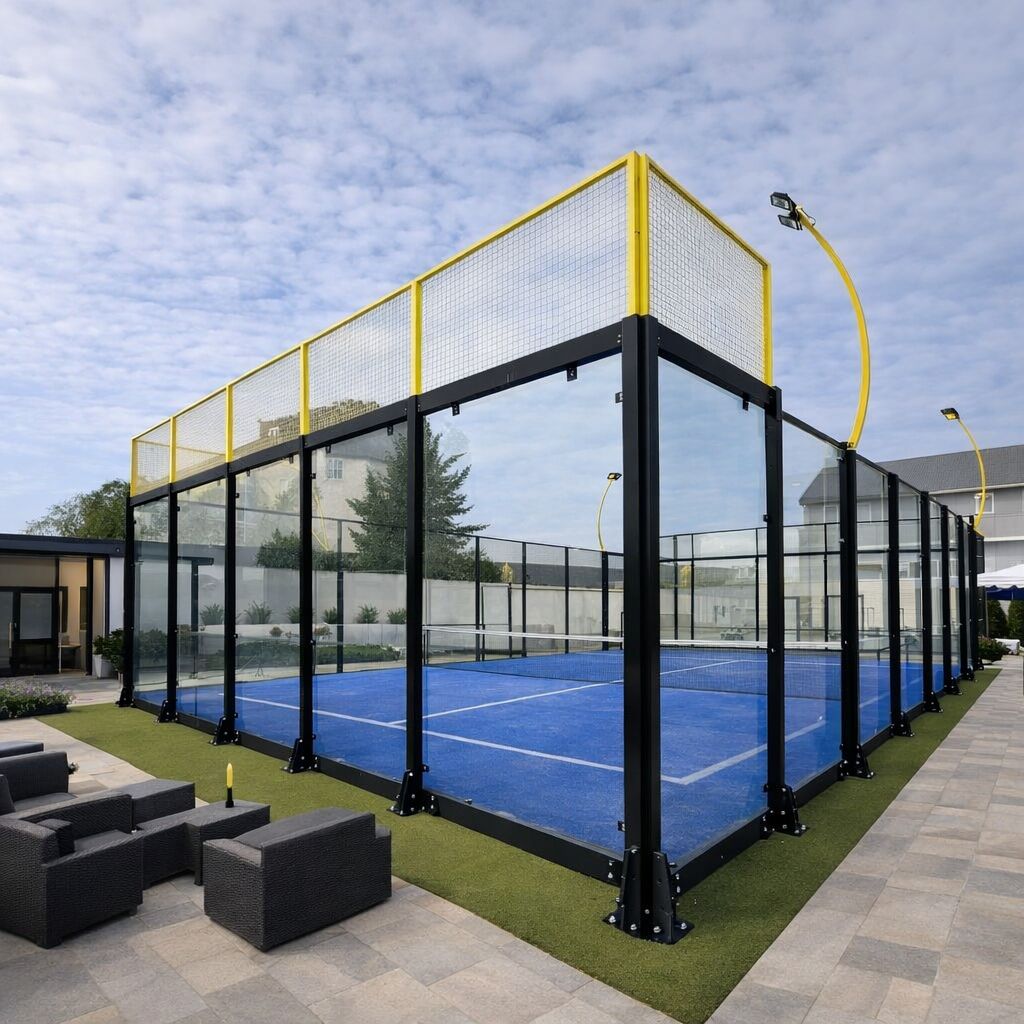
Panoramic court from Newlands Padel. Image credit: Newlands Padel.
Specific engineering standards
The appeal of this approach becomes clearer when the conversation turns to the specific engineering standards required in the UK.
Europe’s best court suppliers have long designed with high wind loads, laminated safety glass, and weather-resistant coating systems. They do so because their products must endure years of heavy use and challenging climate conditions.
Asian factories have historically varied in their interpretation of these standards. However, when provided with clear engineering requirements and overseen by firms willing to reject non-compliant components, they can meet the same specifications at materially different cost levels.
The idea that only Europe can produce courts built for northern climates is no longer accurate. What matters is the quality of the oversight rather than the geography of the factory.
In some cases, this has involved reverse-engineering leading European systems at a granular level, analysing courts component by component and process by process, and then applying equivalent or higher specifications within controlled manufacturing environments, alongside matching warranty standards.
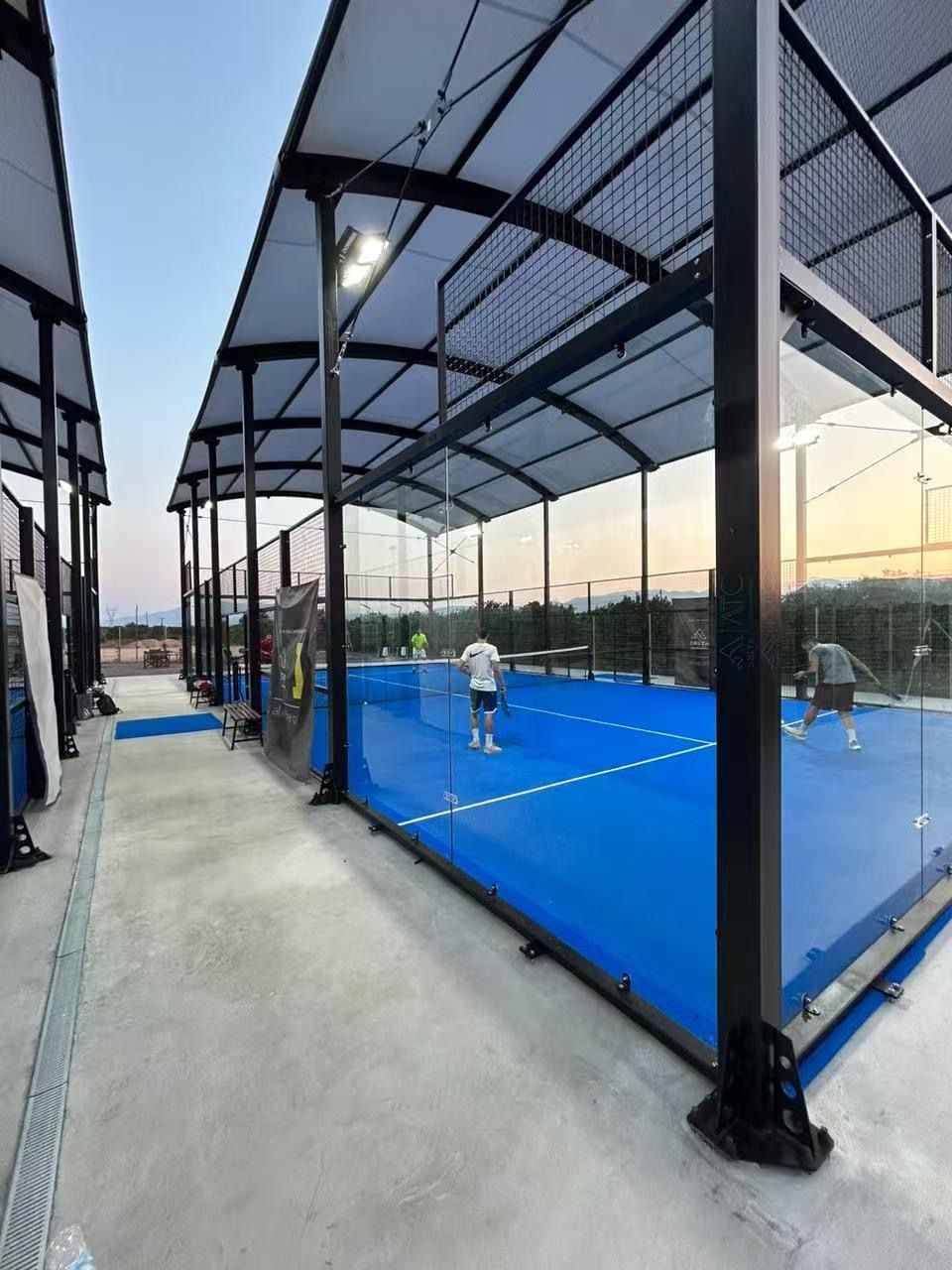
Panoramic court with cover from Newlands Padel. Image credit: Newlands Padel.
Pricing dynamics evolve
Pricing dynamics are also evolving as production capacity increases overseas. The ability to produce at scale, combined with lower labour and material costs, can allow Asian manufacturers to deliver courts with 12mm laminated glass, certified turf, and robust structural steel at a price point that European suppliers find difficult to match.
This cost advantage does not automatically translate into value. Without rigorous engineering validation and quality control, savings become irrelevant.
The interest among UK operators is not driven by a desire for cheaper courts. It is driven by the possibility of courts that do not compromise quality while preserving financial flexibility for the wider project.
There is also a growing recognition that supply chains are not always as transparent as they appear. In some instances, courts manufactured in Asia are already being shipped into European markets before being redistributed to end buyers.
For developers, this raises a more practical consideration around where value is being added within the chain, and whether more direct sourcing models can deliver the same outcome with greater cost efficiency and control.
The central question for developers becomes how to evaluate suppliers in this changing landscape. The old heuristics are no longer reliable. High cost does not guarantee high quality. Low cost does not always imply risk.
The marker of a credible partner is increasingly the presence of a defined process. That includes documented pre-shipment inspections, evidence of engineering certification, transparency around coating systems, control of logistics, and acceptance of full liability for the product from manufacturing to installation.

Beam detail on a Newlands Padel court. Image credit: Newlands Padel.
More nuanced understanding of value
The new economics of padel development are not defined by a race to the bottom or a retreat to historical comfort. They are defined by a more nuanced understanding of value.
As operators build larger and more complex clubs, they are seeking a procurement model that preserves the reliability associated with European engineering while taking advantage of the efficiencies available in global manufacturing.
The rise of integrated sourcing firms suggests that this model is no longer theoretical. It is already influencing the decisions of some of the sport’s most ambitious builders.
The result is a market in transition. Premium quality and premium pricing no longer need to be synonymous. In a sector where capital efficiency and long-term durability have become decisive factors, the third path is beginning to take root.
It promises courts that meet strict standards, supply chains that can be trusted, and economics that make ambitious projects more achievable.
For a sport that is expanding as rapidly as padel, this balance may prove to be one of the defining forces in its next phase of growth.
To get in touch with Newlands Padel and learn more about its integrated padel court solutions, visit www.newlandsgroup.net/padel or contact Alan Scanlan, CEO at: [email protected]
Not yet a PBM subscriber? Sign up here for exclusive weekly insights into the padel industry, delivered directly to your inbox
For more insight and discussion, follow us on LinkedIn and join the conversation