- Padel Business Magazine
- Posts
- PBM Insight Report: What next for padel’s investment drive amid wave of new capital?
PBM Insight Report: What next for padel’s investment drive amid wave of new capital?
Investor appeal: Padel competitions, teams, court operators, tech, apparel and equipment are all sparking interest from venture capital funds and private wealth alike.

Padel Business Magazine
February 27, 2026
Padel is attracting rapidly rising levels of investment in key growth markets such as the UK and US, as well as other emerging regions including the Middle East, following a significant shift in the landscape for the sport globally over the past year. But as the industry begins to mature and become more competitive, what will future investment in padel look like? PBM Insight Report by Laura Syrett and Paul Cochrane.
The last 12 months has witnessed a wave of investment capital entering padel, with a series of major moves in the UK and the US in particular – including sports clubs investing in facilities and sponsors funding infrastructure, players and merchandise.
Driven by its rapid expansion globally, and its attraction as an emerging sport, money from dedicated investment vehicles such as venture capital funds and private wealth from entrepreneurs is now being channelled into all levels of the game, from leagues to clubs to booking apps.
Venture capital, both local and international, has helped oil this fresh investment, especially in the US.
Last September, Virginia-based operator and investor Epic Padel closed an oversubscribed $10 million seed funding round led by NowaisWorld, the sports investment arm of Abu Dhabi-based fund Nowais Inc, and Dubai-based digital investment platform Stryde Ventures, with participation from other venture capital investors and professional athletes, such as retired Egyptian triathlete Omar Nour, former American footballer Tre Boston, and Swedish ice hockey player Nicklas Bäckström.
Epic Padel said it planned to use the capital to launch four to six new US-based clubs across Virginia, Wisconsin, South Carolina and Utah, transforming underused spaces into community sports hubs.
In October 2025, the Pro Padel League (PPL), North America’s professional padel circuit founded in 2022 and launched in 2023 as a series of franchises where clubs pay to join the league, capitalised on a successful second season by securing seed funding in its New York Atlantics club franchise, valuing the club at more than $10 million.
The funding came from a consortium of investors including New York-based investment firms Left Lane Capital and Kactus Capital Management, US businessman Gary Vaynerchuk, and US tennis star Frances Tiafoe.
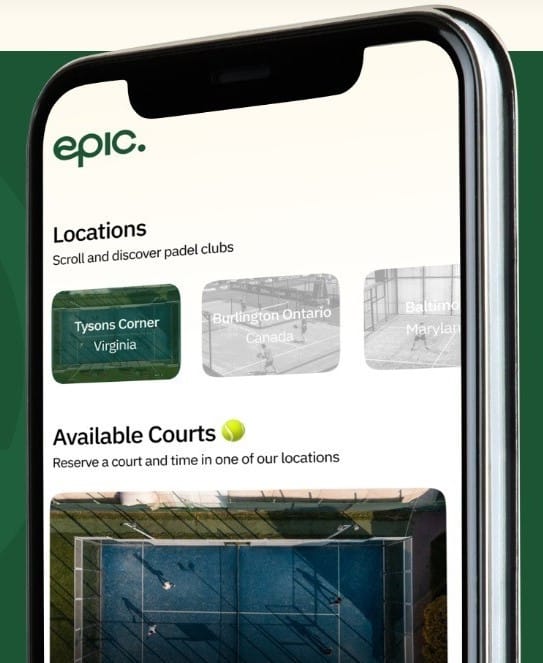
Last September, Epic Padel closed an oversubscribed $10 million seed funding round led by NowaisWorld. Image credit: Epic Padel.
Investors eye opportunities in a fast-growing sport
Arjun Kapur, vice president at Left Lane Capital, tells Padel Business Magazine that investors are eyeing opportunities in padel as it is an emerging, fast-growing sport with global appeal.
“Building on Left Lane’s track record of backing high-growth sports properties – including Kings League [seven-a-side football/soccer], League One Volleyball, The Snow League [winter sports] and Real American Freestyle [wrestling] – our investment in the Pro Padel League reflects our conviction in emerging sports leagues with global potential,” he says.
“Padel’s explosive growth, combined with significant white space in North America, positions the league to scale meaningfully and build a passionate community around the sport. The sport blends athletic intensity, remarkable shot-making and a strong social component – all of which give it real staying power,” he adds.
Since its launch in 2023, the PPL has expanded its franchise model across North America, and it now comprises 10 teams in nine cities and one state: Toronto, San Diego, New York, Miami, Las Vegas, Cancun, Los Angeles, Houston, Orlando and Arkansas.
Over recent months, new external investors have bought into different franchises, giving the teams and the league a significant capital boost.
The PPL New York Atlantics deal was followed in November 2025 when the PPL reported that its Los Angeles Beat franchise had been acquired by a US family investment office run by New Jersey-based logistics magnate David Eisen and his son Corey Eisen for $10 million, the largest single-owner investment in a PPL team since its launch in 2023.

Pro Padel League (PPL) teams New York Atlantics and Los Angeles Beat have attracted significant investment in recent months. Image credit: PPL.
Hybrid investment funds and community ownership models
Another signal of growing investor appetite for padel in the US has come from operators setting up their own hybrid investment funds and community ownership models.
Conquer Padel Club, which owns a flagship facility in Tempe, Arizona, and has plans to open more clubs across the US, has established the Conquer Capital Fund, which aims to sell $15 million in equity to interested shareholders.
Membership interests are priced at $1,000 per ‘interest’, and minimum equity investments start at $50,000, with debt investments also available.
According to Conquer, the planned investment term is expected to span five to seven years, “with a focus on generating consistent returns through a combination of steady membership growth, increasing participation in lessons, clinics, leagues and a robust calendar of tournaments”.

Conquer Padel Club has established the Conquer Capital Fund, which aims to sell $15 million in equity to interested shareholders. Image credit: Conquer Padel Club.
UK padel market attracts fresh investment
Padel investment is also growing in the UK as the market continues to expand rapidly. This is benefiting companies such as London-headquartered sports, media and entertainment investor R3 Sport, which is focused on emerging sports such as padel and pickleball.
Sam Kemp, managing director of operations, tournaments and events at R3 Sport, says padel’s rapid rise from a low base has caught the eyes of investors.
“There is huge first-mover advantage within this early-stage market,” he tells Padel Business Magazine. “With a shortage of quality facilities, tournaments and experiences, coupled with a significant latent demand, padel represents one of the most compelling growth-stage investment opportunities in sports today.”
In terms of returns, Kemp says these can vary widely and are highly dependent on execution, location and cost management, cautioning that “[investor] success isn’t guaranteed”.
He observes: “The padel hype and celebrity involvement has attracted speculative entrants in some areas and inflated the cost of some services which can negatively affect pricing and extend payback periods.”
However, with “the right delivery model,” Kemp says “quality clubs can be a very attractive proposition,” adding that the expanding player base and growing number of courts also supports demand for racquets, balls, apparel and other branded clothing and equipment.

UK No.1 Christian Medina Murphy is among the British padel players backed by R3 Sport. Image credit: R3 Sport.
Kemp notes that padel investment from venture capital is being augmented by money from high-net-worth individuals and celebrities, who are injecting both capital and publicity into events, teams, brands and players.
R3 Sport was itself acquired in November 2025 by padel and pickleball-focused sports and entertainment vehicle VVV Sports, a company listed on the UK’s Aquis Exchange for growing companies. VVV says it has a clear focus on expanding padel’s appeal.
Celebrity former professional athletes have also been boosting UK padel investment. Edinburgh-based operator Game4Padel, for instance, is backed by former male tennis world number one Sir Andy Murray and his brother and professional male tennis doubles player Jamie Murray, among other former professional tennis players as well as English footballers, including Tammy Abraham and Callum Wilson. It is now one of the largest operators in the UK with more than 70 courts across 28 venues.
Playtomic funding round highlights investor interest in padel tech
As well as fresh capital going into competitions, teams and court operators, the growing popularity of padel in markets such as the US and UK has also helped drive significant levels of investment into padel-focused technology businesses.
In March 2025, booking platform Playtomic announced the closure of a major new investment round for $70 million (€65 million), including $65 million (€55 million) in equity funding from backers such as London-based global, independent investment bank GP Bullhound, which first invested in the company in 2018, and €10 million ($12 million) in debt financing from Spanish bank Santander.
The funding is intended to help Playtomic expand globally, including in the US, UK and Germany, and valued the funded platform at around €250 million.
On announcing its participation in Playtomic’s fundraising, GP Bullhound cited padel’s rapid US expansion as helping make the sport and its physical/digital infrastructure attractive to investors.
Playtomic has since raised further capital through a crowdfunding campaign launched via Crowdcube in November 2025, through which anyone aged over 18 can become a shareholder, with stakes starting at €114.
According to Playtomic’s own promotional investment video supporting its crowdfunding drive, the company has raised €110 million ($130 million) from professional investors and the pitch to crowdfunders is targeting rapid growth in this capital. As of February 27 2026 Playtomic had raised over €5.2 million via Crowdcube.
According to details released by Playtomic in September 2025, the company had handled more than €346 million in transactions, up 51% on the previous year, and received €29 million in net revenue, an increase of 38% year-on-year. It connected more than 4.7 million players across 66 countries.

Playtomic co-founders (left to right): chief strategy officer (CSO) Pedro Claveria, CEO Félix Ruiz, and chief commercial officer (CCO) Pablo Carro. Image credit: Playtomic.
Padel tournament organisation and financing expands in the Gulf
Another padel market generating growing interest from investors is the Middle East. Investment is flowing into the sport in the wealthy Gulf Cooperation Council (GCC) region comprising Bahrain, Kuwait, Oman, Qatar, Saudi Arabia and the UAE.
Padel's expanding popularity has been bolstered by new clubs and tournaments catering to local as well as international players. The sport has been given a further boost by state-backed ventures financing tournaments.
“Padel is booming across the Middle East,” observes Gary Davidson, group chief operating officer at 54, a UK-based global sports and entertainment agency, which received investment from Sanabil Investments, a wholly-owned subsidiary of Saudi Arabia’s Public Investment Fund (PIF), in 2021.
The company behind the creation of LIV Golf, 54 is an investor and partner in the new global padel team circuit Hexagon World Series launched late last year.
Davidson notes that Saudi Arabia and the UAE are among the world’s fastest growing padel markets, and that given the GCC has a way to catch up more mature markets such as Spain and Argentina, “for these Gulf nations to be recognised globally shows how much demand there is, and expected to be”.
According to the FIP World Padel Report 2025, Saudi Arabia, which has the GCC’s largest economy and population, at 34.9 million, has an estimated 400,000 padel players and over 1,100 courts, while the UAE, with a population of around 11.5 million, has around 450,000 padel players and 950 courts.
The end of 2025 saw a flurry of tournament-related investment in the GCC, with Qatari government-backed investment fund Qatar Sports Investments (QSI), which founded Premier Padel with the International Padel Federation (FIP) and the Professional Padel Association in 2022, performing a key role.
In December, Premier Padel, in conjunction with Qatar Airways, hosted a week of open-door padel matches attended by Formula 1 stars and global athlete padel enthusiasts in the capital, Doha ahead of the Qatar Grand Prix.
Amid rising global interest in the sport, QSI continues to support the Premier Padel tour’s expansion. In 2026, there will be 26 tournaments across 18 countries, with nearly 75% indoors. In 2025 there were 24 tournaments across 16 countries.

Premier Padel, in conjunction with Qatar Airways, hosted a week of open-door padel matches attended by Formula 1 stars and global athlete padel enthusiasts in Doha, in December 2025 ahead of the Qatar Grand Prix. Image credit: Premier Padel.
Saudi Arabian public and private financing of padel on the up
While Qatar has been the first mover in tournaments and state-backing of padel, Saudi Arabian public and private financing has expanded in the past year. In September 2025, the BSF Padel League was launched by the Saudi Padel Committee, hosting a tournament in 2026 with a prize pool of SAR1 million ($266,666) through a three-year partnership with Banque Saudi Fransi.
And in December 2025, PIF’s 54 teamed up with the Hexagon Cup and FIP to create the Hexagon World Series, the new global professional circuit governed by FIP and designed to complement Premier Padel and the Cupra FIP Tour.
“It is integrated into the professional calendar with players receiving ranking points,” says Davidson. “It sets us at the top of the pyramid, which is great, but doing something a bit different, having fewer players, one show court, and built around teams of men and women. It can be a really complimentary product with what QSI and Qatar are doing with Premier Padel.”
The involvement of PIF, Saudi Arabia’s $1.15 trillion sovereign wealth fund, in padel through 54 and Hexagon events, should drive more interest and investment, adds Davidson.
“Whether private wealth, sovereign wealth, or equity, there is a breadth of interest and capital, and that is needed to be sustainable,” he says. “If it’s only one category of investment really focused on padel, it’s potentially a bit of a risk, whether in the professional game, events, infrastructure, courts or manufacturing.”
He adds: “We are speaking to a lot of investors about the growth of the Hexagon World Series. Investment in sports as an asset class is not exclusively reserved to Middle Eastern money or investment. It is global.”
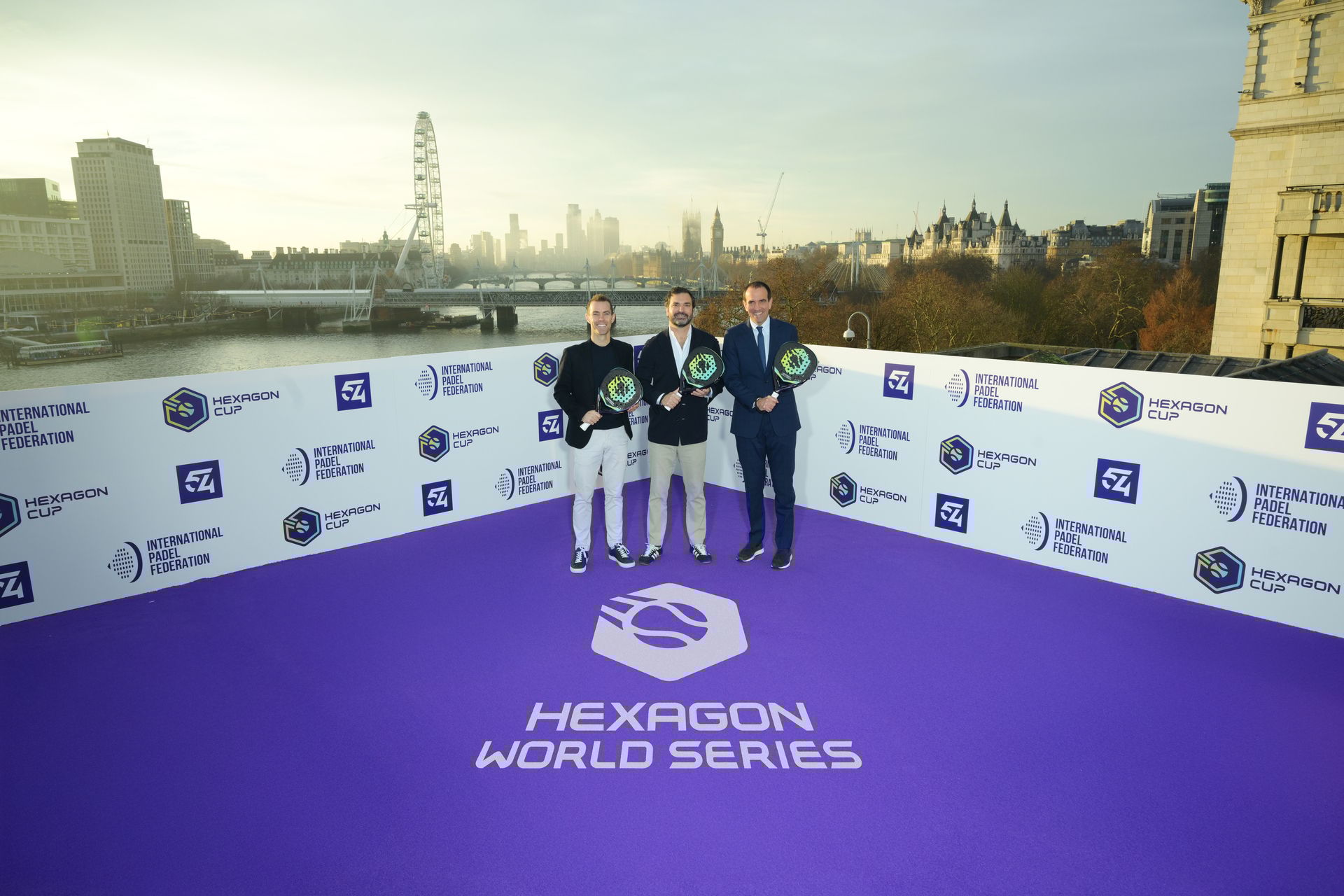
(Left to right) Gary Davidson, group chief operating officer at 54, Enrique Buenaventura, founder of the Hexagon Cup, and Luigi Carraro, president of FIP, at the launch of the Hexagon World Series in London. Image credit: FIP.
Operator Padel In expands across Middle East
Private investment is also playing a role in padel’s expansion in the Gulf. Padel In, a Qatar-based padel franchise with indoor facilities, was set up by two Qatari brothers, Mohammed Saadon Al-Kuwari and Khalid Saadon Al-Kuwari, who have played padel professionally and were keen to grow the sport in the GCC.
Johan Madarasz, general manager of Padel In, stresses that the operator now has clubs across the emirate, and has expanded its network in Kuwait, Saudi Arabia and Pakistan, implementing semi-professional tournaments.
He says financing the competitions comes from sponsorship and registration fees. “We’ve created our own kind of tour, with a season of 10 to 11 tournaments. We have sponsors join us for one year, or more, as sponsoring for one tournament doesn’t bring much value compared to one year of exposure.”
The more players, the more return for sponsors. “The vision is for everybody to compete. We have four, sometimes five categories, from the A level to E. People love to compete,” says Madarasz.
He stresses that prize money ranges from Qatari Riyal QAR54,600 ($15,000) to QAR91,000 ($25,000), varying by category, from national professional players from the GCC, as well as international players. Padel In works with sponsors for branding at clubs, hosting events for VIP customers of the sponsors, and networking events.

Padel In, a Qatar-based padel franchise with indoor facilities, was set up by two Qatari brothers who have played padel professionally. Image credit: Padel In.
Rising levels of prize money in Saudi Arabia
Ibrahim Akeel, CEO of Flex League, a Saudi-based sports-tech startup platform that enables players to join flexible competitions, book courts and track performance, notes that two major regional tournaments were held in the country last year.
“One of the events, the Brew92 Cup, had prize money of Saudi Riyals SAR100,000 ($26,666). Two months later the prize money was SAR200,000, both sponsored by local brands such as Brew92. It shows [there is] more sponsorship of big tournaments,” he says.
Saudi car rental company Theeb also organised its ‘Theeb Elite Padel Cup’, with total cash prizes of SAR130,000 ($34,666) plus a car.
The Saudi Padel Committee, which became an official federation last year, is also increasing funding for the sport in the country, with more tournaments and events, as it seeks to popularise the sport.
“The main focus of the federation is to increase the exposure of players, through big tournaments,” observes Akeel. “But they also want to have a new direction, to promote smaller scale tournaments [attracting] amateur players”, who can compete with people of similar skillsets.
“So while before everyone could join tournaments, now it will be more than three categories,” making games more competitive, he adds.
But while state funding for Saudi padel has increased, there has not been investment so far in public courts, which Akeel hopes will be the next step to heighten padel’s uptake in the kingdom.
Expectation that padel could become an Olympic sport in 2032, staged in Brisbane, could drive further investment in the sport in Qatar, Saudi Arabia and beyond given Qatar’s hosting of the FIFA World Cup in 2022, and Saudi Arabia hosting more major sports events and potentially bidding to host the 2036 Olympics.
Davidson says: “This could be massive from a funding point of view, and how padel is integrated into national curriculums, if Saudi Arabia, the UAE and Qatar put it in among their Olympic programmes.”

Funding is increasing for padel in Saudi Arabia, with more tournaments and events. Image credit: International Padel Federation (FIP).
Major sponsors turn their attention to padel
Organisers are also keen to attract sponsorship from global brands that have not traditionally considered padel as part of their global portfolios. “This is changing. Qatar Airways and Heineken are sponsors of the [UEFA football] Champions League, and are now big sponsors in padel,” observes Davidson.
He also points to padel world number one Arturo Coello signing a partnership with Rolex in January 2026, which Davidson says “is huge, as its sports portfolio was golf and tennis focused”.
He argues that bolstering media coverage of padel events requires a shift, however, with TV and media broadcasting having been almost exclusively reported in Spanish due to 85% of the top 100 players being from Spain and Argentina.
“This makes sense in who is following and the fan base, but as padel evolves, that will change,” he points out. “We saw similar things in women’s golf with the influx of Japanese and Korean talent into the LPGA Tour, whilst it continues to be reported in English, attracting global brands and transcending cultural and geographic barriers. That is the next phase, for sponsors to invest in the sport and follow the fan base.”
Not yet a PBM subscriber? Sign up here for exclusive insights into the padel industry, delivered directly to your inbox
For more insight and discussion, follow us on LinkedIn and join the conversation